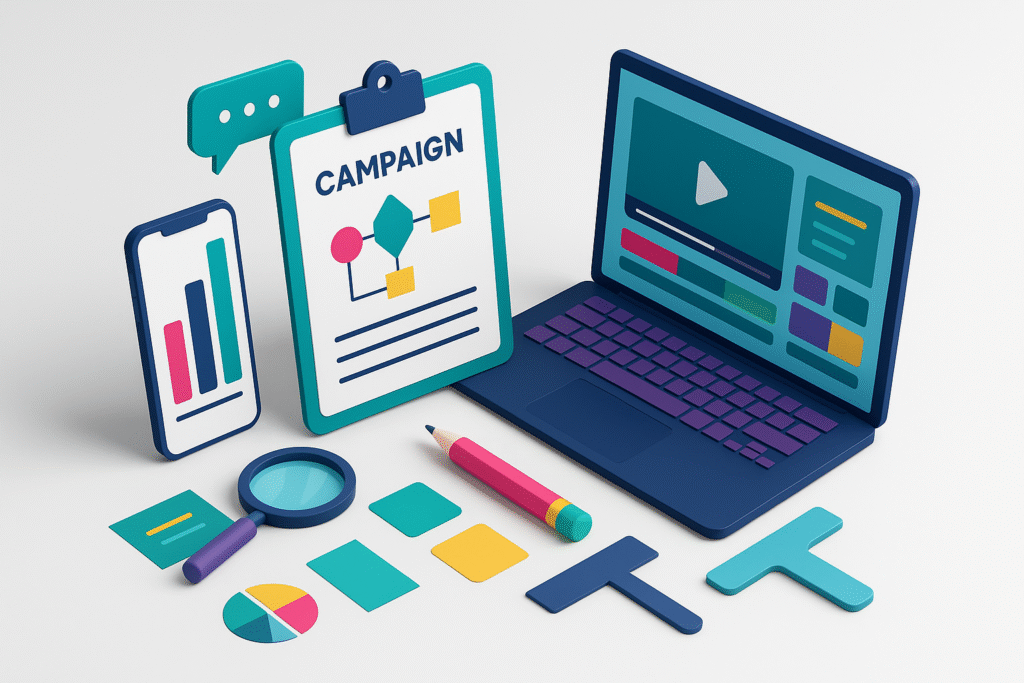
Creative production can make or break a campaign
When a campaign falls flat, it’s rarely because the idea was poor. More often, it’s due to a breakdown somewhere in the production process. From unclear briefs to inconsistent execution, small mistakes can undermine months of strategy and creative thinking.
At Datum, we see it all the time – campaigns that start strong but lose impact in delivery. The good news? Every one of these mistakes is preventable with the right process, communication and attention to detail.
Here are the five biggest creative production mistakes that can kill campaign impact, and how to avoid them.
1. Rushing the Brief
Every great campaign starts with a great brief. Yet, this is where many projects go wrong. A vague or incomplete brief leads to wasted time, unclear expectations, and creative that doesn’t quite fit the purpose.
A strong brief is more than a few bullet points. It’s a detailed roadmap covering:
- The campaign objective
- Audience insight
- Desired tone of voice
- Channels and formats
- Timelines and measurable goals
At Datum, we call this our Creative Scoping Stage – where we interrogate the brief before any design, filming, or printing begins. This ensures every piece of creative work serves a purpose, aligns with your brand, and delivers measurable results.
Quick Answer: How long should a good brief take?
Typically, one to two collaborative sessions are enough to refine a clear, focused brief. The time invested here saves weeks of back-and-forth later.
2. Ignoring the Channel Early On
One of the most common creative pitfalls is designing “one size fits all” content. A 16:9 video may look great on desktop, but loses its punch when cropped to vertical for Instagram Stories. Likewise, a beautifully printed layout can feel cluttered when translated directly to digital.
Each channel has its own visual logic.
That’s why at Datum, we design with channel-first thinking – defining output sizes, file types, and user context right from the start. The result? Campaign assets that stay consistent in look, tone, and quality whether viewed on a billboard, website, or social feed.
Quick Answer: Why does channel-specific design matter?
Because attention spans differ. What works for print may not hold attention in a scroll. Designing for each platform ensures clarity and impact wherever your message appears.
3. Over-complicating the Message
Creative teams often fall into the trap of trying to say too much. Multiple headlines, competing calls to action, and cluttered design layouts confuse the viewer and dilute the main message.
The best campaigns are simple and confident.
They say one thing well – and make it easy to act on. Before you sign off any creative, ask:
- Is the message clear in five seconds?
- Does every visual element reinforce that message?
- Is there just one call to action?
At Datum, we often remind clients: if everything shouts, nothing is heard. Simplifying the message not only makes it stronger – it makes it memorable.
4. Neglecting Production Values
Even the strongest creative concept can be ruined by poor production values. Low-resolution imagery, uncalibrated colours, or budget-cut print stock instantly cheapen the brand.
Creative excellence is about craft.
That means checking file formats, lighting setups, paper weights, sound mixes, and typography consistency before anything goes live. Whether it’s a Bollinger film at The Dorchester or a local direct mail campaign, our approach is the same: precision at every stage.
Because when production looks professional, your brand does too.
Quick Answer: How can you maintain quality on a budget?
Prioritise what matters most for visibility. Lighting and sound often matter more than fancy transitions in video; for print, paper finish and ink density have the greatest impact on perception.
5. Forgetting the Follow-Through
Many campaigns are beautifully produced but poorly maintained. They launch, make an initial splash – and then disappear. No tracking, no repurposing, no analysis.
A campaign without follow-through wastes potential.
At Datum, we plan the entire campaign lifecycle:
- Tease: Pre-launch awareness and anticipation
- Launch: Main creative reveal
- Amplify: Social adaptation, retargeting, local PR
- Measure: Analytics, ROI reports, creative insights
- Repurpose: Adapt content for future campaigns
This not only extends campaign lifespan but maximises ROI. Smart brands treat production as the start – not the finish – of the conversation.
Datum’s Creative Production Checklist
Before pressing publish or sending to print, ask yourself:
- Is the brief clear, approved, and measurable?
- Are assets optimised for each channel?
- Is there one core message and call to action?
- Have you checked colour, sound, and resolution?
- Is there a plan to monitor results and repurpose assets?
If you can confidently tick all five, you’re in a strong position to launch a campaign that performs.
FAQs: Common Creative Production Questions
Quick Answer: What does ‘creative production’ mean?
It’s the process of turning creative ideas into finished deliverables – from print and video to digital and outdoor campaigns. It includes design, artwork, production, proofing, and delivery.
Quick Answer: What industries benefit from better creative production?
Every industry that communicates visually. From education and finance to retail and hospitality, clear and consistent creative production builds trust and drives engagement.
Quick Answer: How can Datum help improve campaign production?
We manage everything from concept to delivery – ensuring your brand looks consistent across print, digital, and video. We spot the pitfalls early so your campaign launches smoothly and professionally.
Audience Takeaway
Working with Datum means you gain a partner who understands how creativity and precision combine to deliver real results. We don’t just make things look good – we make them work hard across every channel, from the first concept to the final impression.