In today’s competitive education environment, your school or college’s prospectus is much more than a booklet – it is a key strategic asset. It not only communicates your values, culture and curriculum, but also helps families decide whether your institution is the right place for their child. At Datum, we have worked with education clients to produce print‑and‑digital collateral that supports long‑term partnerships and retained marketing programmes. In this blog we explore the three most important “prospectus design trends” for 2026, show what they mean in practice, how you can apply them, and why working with Datum gives you value in the long term.
Why design trends matter for school enrolment
The right prospectus design does more than look good – it builds trust, reflects your brand identity, and speaks directly to families’ concerns. As noted, a well‑designed prospectus helps shape first impressions, build credibility and clearly articulate your offer.
By aligning your prospectus with current design and communications trends, you ensure you are relevant, engaging and memorable. That helps drive enquiries, visits and ultimately enrolments.
Audience takeaway
If you work with Datum to update your prospectus, you will get:
- A design that reflects your brand, ethos and competitive edge.
- Both print and digital versions, integrated for maximum reach.
- A piece of marketing collateral that truly supports your enrolment strategy (not just a one‑off).
- A route into a retained studio partnership (monthly retainer) so your design and print assets evolve as your school does.
Trend 1: Hybrid Print + Digital Formats
What this means
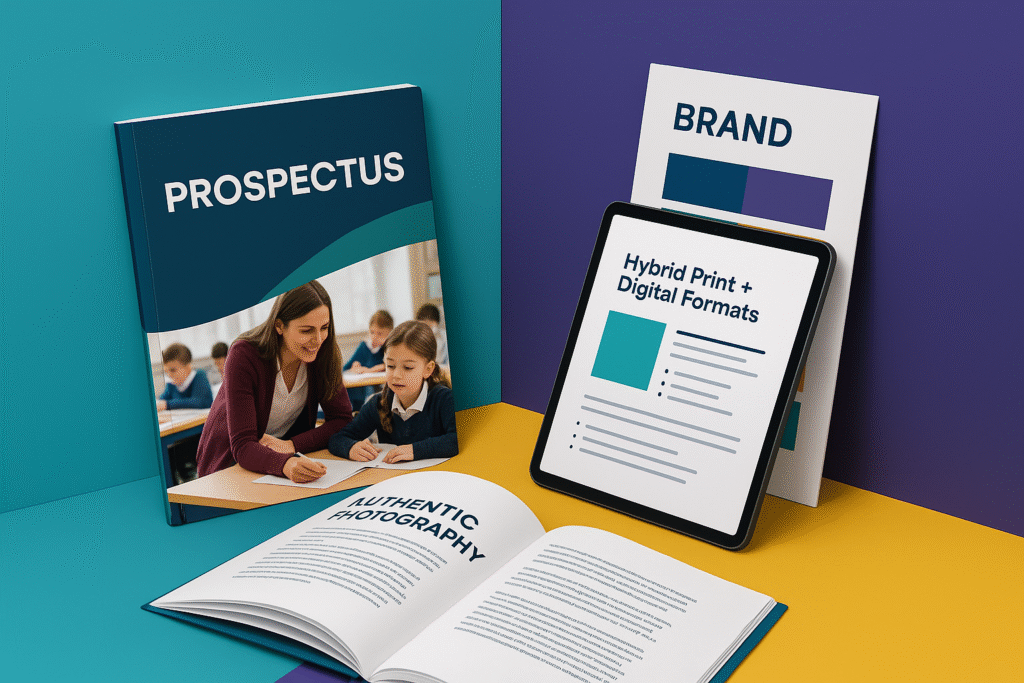
While printed prospectuses remain vital (especially for open events, tours and mail‑outs), digital formats are now equally important. Schools are using interactive PDFs, online flipbooks or microsites to reach families remotely or share instantly. For example, many designers now emphasise “digital versions for sharing via email newsletters or social media”.
Hybrid means your design system supports both physical and online channels—with seamless branding, responsive layouts and consistent messaging.
Why this matters for 2026
- More families expect a digital‑first experience. A prospectus that is only in print may feel outdated.
- Digital formats provide analytics (how many views, which pages were clicked) and can be updated quicker between print runs.
- Print still has gravitas: a nicely finished booklet has tactile impact and can be kept by parents.
Combining both means you maximise reach and reinforce your message.
How to apply it (step‑by‑step checklist)
- Review your current prospectus: print format, digital version (if any), branding alignment.
- Decide on a print specification (size, stock, finishes) and a digital format (PDF, flipbook, interactive).
- Design with flexibility: ensure the layout works both for A4 (or chosen print size) and for screen (tablet/mobile).
- Ensure branding consistency: colours, logos, fonts must work across print and digital.
- Test the digital version: check load times, readability on mobile, accessibility.
- Plan distribution: printed copies for events; digital version on your website and in emails/mailshots.
- Review and update regularly: your digital version allows rapid changes (dates, statistics, testimonials) without a full re‑print.
Trend 2: Authentic Photography and Story‑Led Content
What this means
Parents and carers don’t just want facts—they want to understand what life is like at your school. Design tips emphasise the use of “real images of your students and staff. Show learning in action.”
Story‑led content means including case‑studies, testimonials, day‑in‑the‑life visuals, and clear narrative around your school’s culture and values, rather than just lists of facts.
Why this matters for 2026
- With information overload, you need to stand out by telling your story.
- Authentic photography builds trust—stock images can look generic and less credible.
- Narrative content helps families imagine their child in your school and feel connected.
- It also reinforces your brand identity and gives material for social media reuse.
How to apply it
- Commission a photography session: capture classroom moments, extracurricular activities, staff‑pupil interaction, school grounds, community events.
- Write story‑led copy: e.g. “Meet Alex—joined us in Year 7, is now head of eco‑club…” or “How our wellbeing programme supports students every day…”
- Use design layout that emphasises story: large engaging images, pull‑out quotes, clear short paragraphs.
- Avoid information overload: clear headings and digestible blocks help readability.
- Repurpose content: use the photos and stories in brochures, your website and social channels to maximise ROI.
Trend 3: Flexible Design Systems and Future‑Proof Branding
What this means
Rather than creating a one‑off prospectus, schools are moving towards design systems: templates, components, modular layouts that can be updated year‑on‑year. Designers note that tailored design (not simply templates) helps maintain uniqueness.
Future‑proof branding ensures that your look remains relevant, but also adapts easily for changes (e.g. new programmes, new buildings, digital channels). A flexible design system makes updates quicker, reduces cost and supports a retained partnership.
Why this matters for 2026
- Schools are dynamic: curriculum, staff, facilities and branding evolve. A rigid prospectus quickly becomes outdated.
- A flexible system supports ongoing enrolment marketing, updates, and seamless roll‑out of new versions.
- It supports retainer‑based relationships: at Datum we build and maintain your design system as part of a monthly retainer, so you’re always ready for the next intake.
- It also allows consistency across print, website, signage, social templates—so your brand feels unified.
How to apply it
- Audit your current branding: fonts, colours, logo usage, photography style, tone of voice.
- Develop a design system: define components (cover page, section intro, staff profile, student story, stats page) that can be reused.
- Create templates for print and digital: so each year you update, rather than redesign.
- Set a schedule: e.g. an annual update, plus ad‑hoc updates if there are significant changes.
- Incorporate brand‑evolution guidelines: allow the design system to accommodate new colours, new programmes, new media channels, with minimal disruption.
- Work with a partner (like Datum) on a retainer: we handle annual updates, design variations, print management, digital version roll‑out, and ensure you’re enrolment‑ready at all times.
Bringing It Together – Why Work with Datum
At Datum, our approach aligns with these trends and goes further. We offer a full studio service across Creative, Print and Digital sectors: from branding and logo design, through to prospectus, stationery, event materials, and website build. We also offer retained studio support, so your school has continuous help throughout the year rather than a one-off project.
Benefits to you:
- A partner who understands both education sector demands and high‑quality print and digital execution.
- A seamless workflow: creative concept, print management, digital asset build, distribution planning.
- Cost control and predictable budgeting through a retainer model.
- An evolving design system that keeps your prospectus and wider brand current, without starting from scratch each year.
- A final product that reflects your school’s identity and supports your enrolment goals for 2026 and beyond.
FAQs (Quick Answers)
What is a “design system” for a school prospectus?
- It’s a set of reusable design components (templates, layouts, typography, colour palette) that ensure consistency across print and digital editions.
- It allows easier updates each year rather than a full redesign.
Do we still need a printed prospectus, given digital alternatives?
- Yes — printed versions remain important for open events, tours, mail‑outs and as a physical keepsake.
- Digital versions complement print by enabling easy sharing, updates and remote access.
How often should we update our school prospectus?
- Major updates annually to reflect changes (staff, curriculum, facilities).
- Minor updates (statistics, photos) as needed for digital versions or short‑runs.
- Using a design system shortens the update timeline and cost.
What role does photography play?
- Real, in‑school photography conveys authenticity and helps families imagine their child at your school.
- Photographs become assets across your marketing (brochure, website, social).
How do we ensure the prospectus supports enrolment, not just image?
- Focus on clear messaging about your school’s strengths, values, outcomes.
- Use story‑led content and testimonials to connect with families emotionally.
- Ensure contact and next‑steps (apply, visit, call) are clearly visible and accessible.